A unified national moment from the Tutu Peace Lecture
In a year marked by heightened conflict and fraying social trust, over a thousand people gathered at the Cape Town International Convention Centre for the sold-out 15th Desmond Tutu International Peace Lecture, a living testament that unity is not abstract, and peace is not passive.
The afternoon brought together global thought leaders, local communities, young voices, artists, activists, and families. What emerged was not merely an event, but a collective act of moral imagination: One world. Many voices. One message of peace.
Shashi Tharoor echoing Desmond Tutu: “If you want peace, you talk to your enemies, not your friends.”
Delivering a keynote that blended provocation and moral clarity, Dr Shashi Tharoor challenged South Africans and the world to examine the roots of division and the responsibilities of faith and identity.
Among his reflections: “Peace is not born in isolation. Peace is the courage to admit we are wrong. Tolerance is supposed to be a virtue, but it is in fact patronising. We must replace tolerance with acceptance.”
He closed with a question that echoed long after he left the stage: “What kind of faith will we practice and what kind of peace will we pursue?”
Janet Jobson: “Hope is discipline. Peace is labour.”
Reflecting on the significance of the 15-year milestone, CEO Janet Jobson offered a message anchored in clarity and conviction: “Hope must be practiced, not presumed. Peace is labour, courageous, demanding, profoundly human. Today reminded us that peace is not sentimental. It is something we do, not something we wait for.”
She added: “For fifteen years, this Lecture has been a lantern carried through darkness, small, steady, stubborn in its insistence that peace is still possible.”
A Global Chorus on the Peace Wall
A central moment of the event was the premiere of the live Peace Wall video installation, an emotional mosaic of letters, drawings, poems, and spoken messages received from around the world.
Messages of peace arrived from across South Africa and far beyond, including contributions from, Sir Richard Branson, Forest Whitaker, Zakes Bantwini, Cape Town Mayor Geordin Hill-Lewis and youth contributors, artists, activists and families, among many others.
Set to an original soundtrack titled “Letters of Peace”, produced by 19 Sound (London) and composed by Jack Wyllie and Will Ward, the installation drew sustained applause as Archbishop Tutu’s belief that “words can be bridges” came alive on screen.
The Peace Wall was anchored by the campaign’s core message:
From every corner of our country, words become bridges. Every message, every act of kindness, every word of hope… becomes part of something greater. This is peace in action, written by many, lived by all. Peace is the presence of justice, love, and action, one letter, one word, one person at a time.
Youth Voice: Trisha from Wallacedene Primary Halted the Room
The Lecture amplified young South Africans as moral leaders of the present, not the future.
Trisha, a learner from Wallacedene Primary School, delivered a reflection that grounded the theme of shared humanity in the everyday reality of children navigating an unequal society.
Her message, honest, urgent, unfiltered, reminded the audience that peace is a discipline taught at home, at school, and in community, long before it becomes national policy.
Rev. René August: Truth, Justice, and the Courage to See Clearly
The afternoon’s moral centre was sharpened by theologian and activist Reverend René August, who reframed peace as impossible without truth-telling. Her message was direct: There can be no peace without justice. No reconciliation without truth. No unity without dignity.
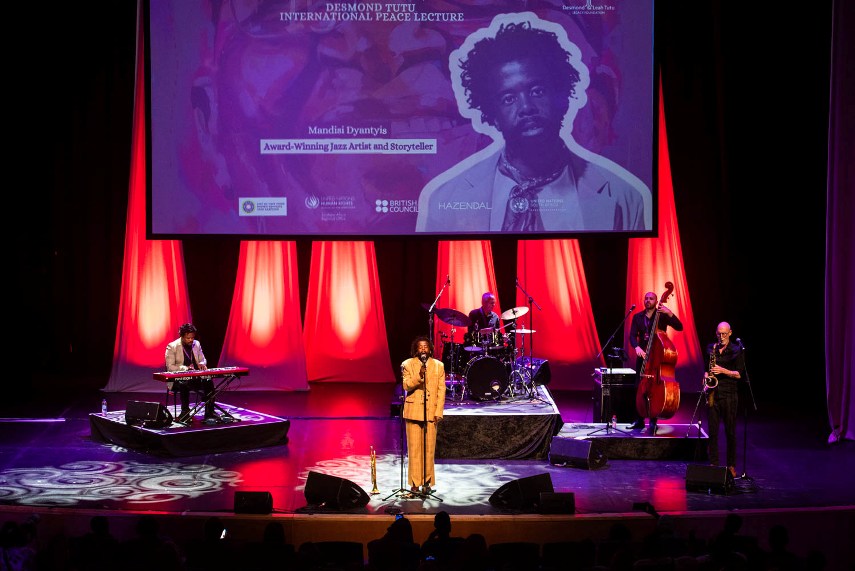
Mandisi Dyantyis Bought the House Down
Music, Tutu’s joyful form of resistance became a living sermon when Mandisi Dyantyis took the stage. With jazz, soul, Xhosa tradition, and spiritual depth woven into one performance, he didn’t just entertain the room; he transformed it. The standing ovation said everything: Music transcends. Music restores. Music brings peace where words fall short.
Standing With Women for Change: A Commitment Beyond the Lecture
As part of its ongoing commitment to justice and human dignity, the Desmond & Leah Tutu Legacy Foundation has closed its doors today in solidarity with the Women for Change national shutdown against gender-based violence.
This action reinforces the Arch’s conviction that neutrality in the face of injustice is never an option.
“Fifteen years on, this Lecture reminds us that peace is not an outcome, it’s a choice. It’s the choice to show up, to listen, to act, and to see one another fully,” said Jobson. “What began as an act of resistance has become a moral tradition that grows each time ordinary people decide that peace is their responsibility too – the work continues.”